EveryCare
Senior-care coordination. One workspace for solo self-care, families, and professional caregivers. Formerly GenxCare and MeraCare.
Visit live siteWhat it covers
Tech stack
The challenge
Families and professional caregivers coordinate daily care across texts, calendars, and memory. Seniors need independence, not surveillance. Caregivers need a shared place for tasks, medications, appointments, and a calm record of what actually happened.
Collaboration
I created EveryCare and led it myself: the care-circle model, the Expo app, and the Go API. There was no separate client team. The product decision was coordination rather than monitoring, and I took that from the domain model through to a shipped open-source app.
From discovery to production
- One app for solo self-care, family care, professional caregivers, and mixed circles — not a separate caregiver binary
- Care circles and invitations, with permissions based on the relationship to the senior
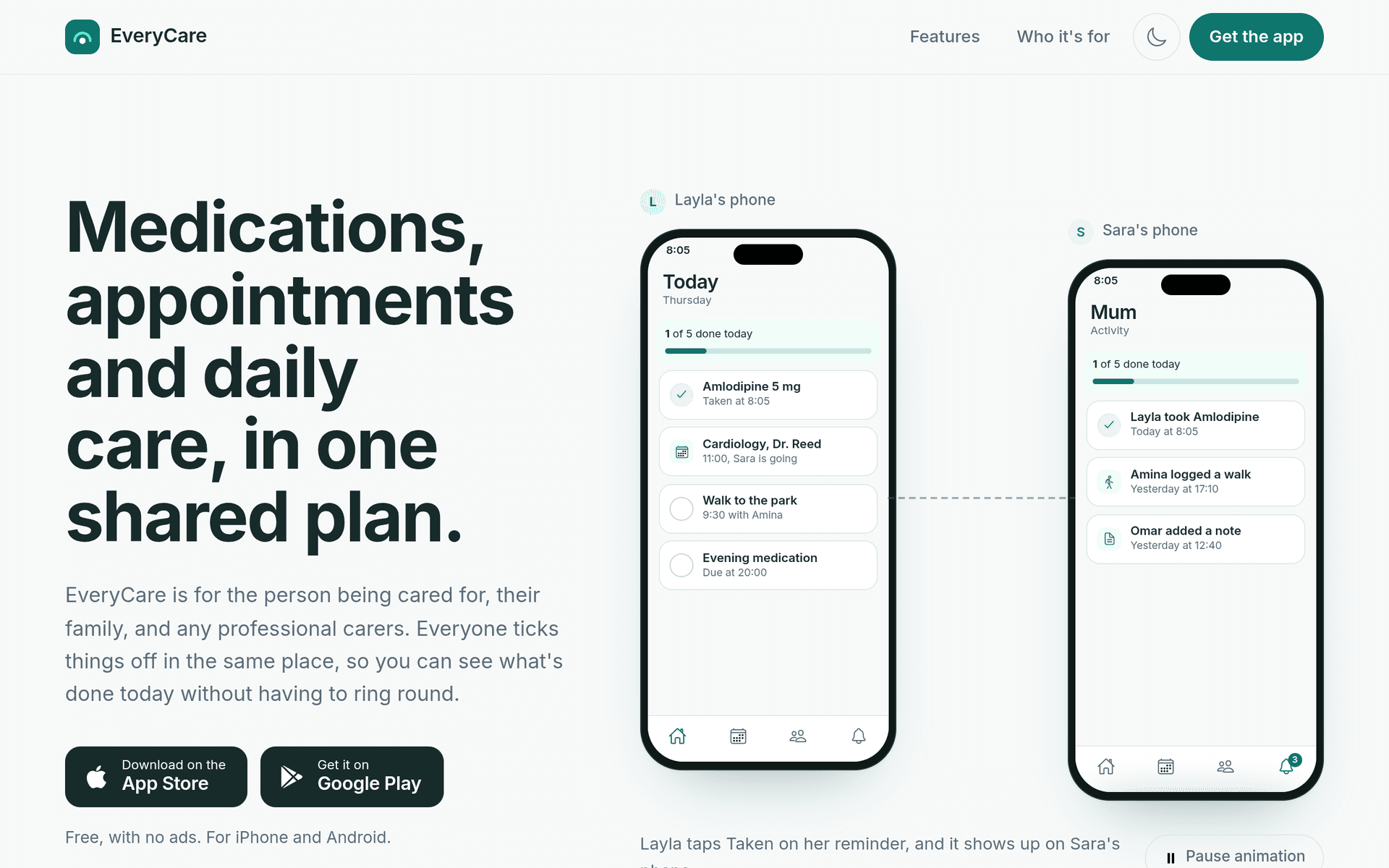
- Recurring tasks, medication schedules, appointments, notes, and per-senior messages
- An activity timeline written from immutable care events, not from UI state
- Offline core flows on the device, with Apple and Google sign-in
- A path from using it alone to inviting family or professionals later
How it was solved
The Expo app keeps server state in TanStack Query, UI state in Zustand, and durable offline data in expo-sqlite. The Go API is a modular monolith with a versioned REST contract, not a set of microservices. PostgreSQL, Auth, and storage are Supabase. The API owns the business rules. What a person can see follows their relationship to the senior. A command writes a care event in the same transaction, and that event is the timeline and the notification source.
Key technical decisions
- 01One app and four modes. The relationship decides the UI, so families and professionals are not two products that have to stay in sync.
- 02A Go modular monolith and versioned REST, instead of microservices for a domain that is still one product.
- 03Server state, UI state, and offline data in three different places: TanStack Query, Zustand, and SQLite.
- 04Supabase for Postgres, Auth, and storage, with the Go API owning the care rules.
Screenshots
Impact
- Seniors, families, and professional caregivers coordinate in one product.
- A person can start alone and invite others later, without switching apps.
- The timeline is an event log of what happened, not a screen that can be edited into a different story.
- Medical information is coordinated, not diagnosed. The product does not claim an AI diagnosis.
What I learned
In care software, the relationship model is the product. Permissions should follow who you are to the senior, not which app you installed.